US AI Compliance Deadline 2026: What Businesses Must Do Before June 30
The June 30 AI compliance deadline is approaching in the United States. Learn how new AI regulations could impact businesses, software providers, and AI-powered products.
Kartik Gauttam
Community
4 min read
TechZolo Journal
US AI Compliance Deadline Approaching: A Critical Moment for AI Companies
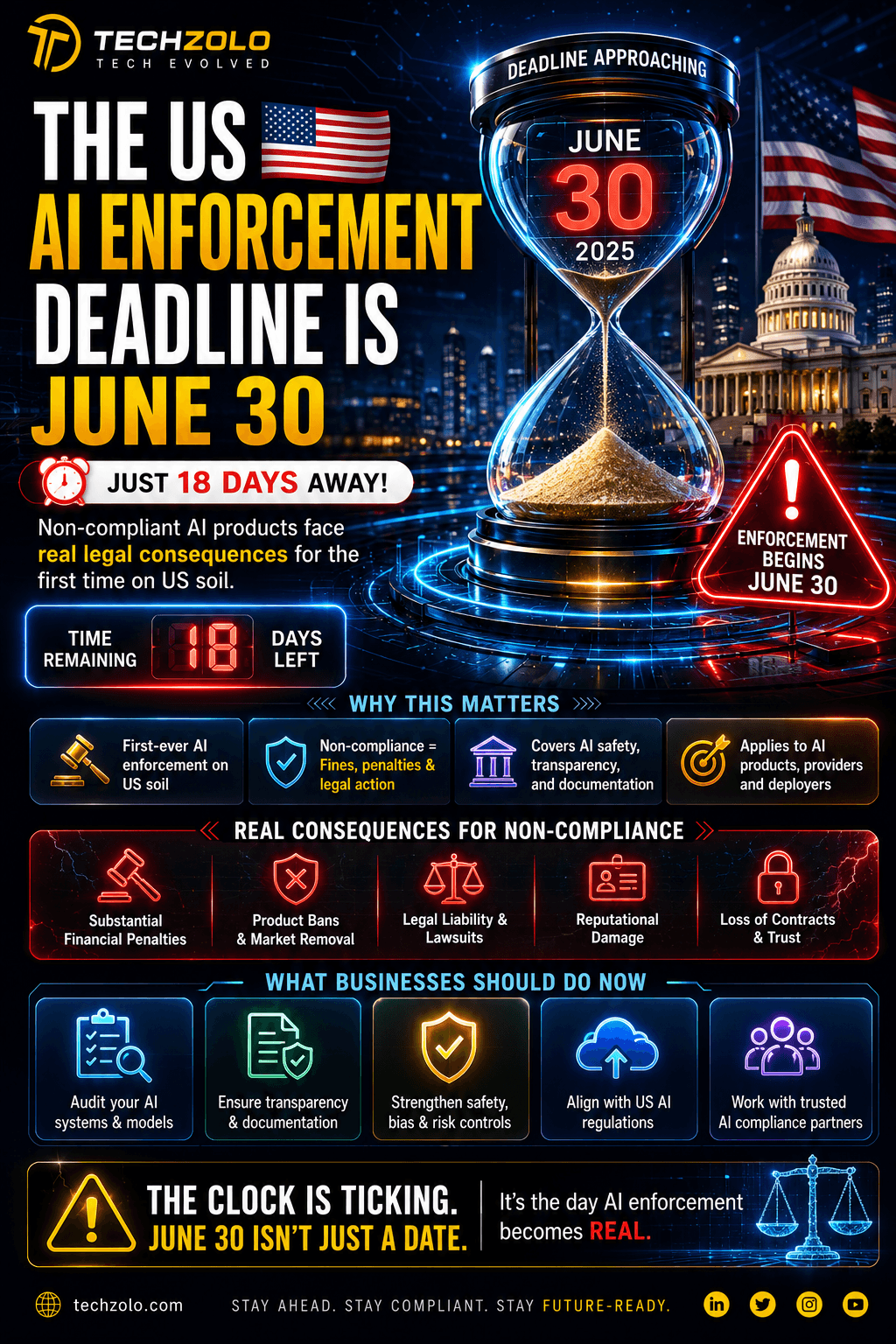
Artificial intelligence is entering a new phase of regulation. With the June 30 compliance deadline fast approaching, organizations deploying AI-powered products and services in the United States are facing increasing pressure to ensure regulatory compliance.
For the first time, businesses offering non-compliant AI systems may face tangible legal, financial, and operational consequences on US soil. This marks a significant shift from voluntary AI governance toward enforceable regulatory oversight.
As AI becomes deeply integrated into software, customer service, healthcare, finance, and enterprise operations, compliance is no longer optional—it's becoming a business necessity.
Why the June 30 AI Compliance Deadline Matters
Governments and regulatory agencies worldwide are working to establish guardrails around AI technologies. The upcoming US enforcement milestone signals a growing emphasis on:
AI transparency
Responsible AI development
Data privacy protection
Risk management frameworks
Consumer protection
Bias and fairness mitigation
Security and accountability standards
Organizations that fail to meet applicable requirements could face penalties, legal challenges, operational restrictions, or reputational damage.
What Businesses Should Review Immediately
1. AI Governance Policies
Companies should establish clear policies covering:
AI model usage
Human oversight
Data handling procedures
Risk assessment processes
Incident response protocols
Strong governance frameworks help demonstrate responsible AI practices and regulatory readiness.
2. Data Privacy and Security
AI systems often process large volumes of sensitive information.
Organizations should verify:
Data collection practices
User consent mechanisms
Storage and retention policies
Access control procedures
Security monitoring systems
Privacy compliance is increasingly becoming a foundational requirement for AI deployment.
3. AI Transparency Requirements
Businesses should understand:
How AI decisions are generated
Whether users are informed when interacting with AI
Documentation requirements for AI systems
Explainability standards for automated decisions
Transparent AI builds both regulatory confidence and customer trust.
4. Bias and Risk Assessments
Regulators are paying close attention to potential discrimination and unintended outcomes generated by AI systems.
Organizations should regularly conduct:
Bias testing
Model validation
Performance monitoring
Risk assessments
Compliance audits
Proactive evaluation reduces legal and operational exposure.
Industries Most Likely to Feel the Impact
Financial Services
AI-powered lending, fraud detection, and customer support systems face heightened scrutiny due to their impact on financial decisions.
Healthcare
Healthcare organizations using AI for diagnostics, patient engagement, and administrative automation must ensure compliance with strict privacy and safety requirements.
Human Resources
Recruitment and hiring platforms utilizing AI screening tools are under increasing review for fairness and discrimination concerns.
Software and SaaS Companies
Organizations embedding AI into commercial products may need additional documentation, monitoring, and governance measures.
The Business Risk of Waiting
Many organizations have focused on AI innovation while delaying compliance planning.
However, regulatory enforcement introduces new business risks:
Legal penalties
Regulatory investigations
Product deployment restrictions
Loss of customer trust
Increased compliance costs
Reputational damage
Forward-thinking companies are treating AI compliance as a competitive advantage rather than a regulatory burden.
AI Compliance Is Becoming a Strategic Business Priority
The AI industry is transitioning from rapid experimentation toward mature governance frameworks.
Businesses that invest early in:
Responsible AI practices
Security controls
Compliance frameworks
Documentation standards
Risk management systems
will be better positioned to scale AI initiatives confidently while meeting evolving regulatory expectations.
How Techzolo Helps Organizations Build Compliant AI Solutions
At techzolo.in�, we help businesses develop and deploy AI-powered solutions with scalability, security, and governance in mind.
Our expertise includes:
AI Application Development
Generative AI Integration
Enterprise Software Solutions
Business Process Automation
Secure Cloud Deployments
AI Governance Consulting
Custom Web & Mobile Development
As AI regulations continue to evolve, organizations need technology partners who understand both innovation and compliance requirements.
Final Thoughts
The June 30 AI compliance deadline represents a turning point for the AI industry in the United States. Regulatory enforcement is no longer a future possibility—it's becoming a present reality.
Businesses that prioritize AI governance, transparency, security, and accountability today will be better prepared for the next generation of AI regulation and enterprise adoption.